


Ordinary carbon steel often suffers from rapid rusting and premature failure in outdoor or industrial environments, which increases maintenance costs and shortens service life. In contrast, S235J2W Corten Steel (EN 10025-5) is renowned for its excellent corrosion resistance. What specific advantages does it have over ordinary carbon steel in this regard? The core lies in -two key features that fundamentally slow down corrosion. Below is a concise, actionable breakdown.
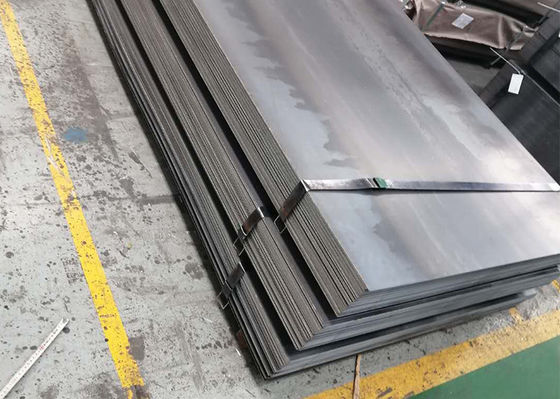
1. Core Advantage 1: Alloy Composition Tailored for Corrosion Resistance
The biggest difference between S235J2W and ordinary carbon steel (e.g., S235JR, Q235) lies in the addition of weather-resistant alloy elements, which are absent in ordinary carbon steel:
: S235J2W contains >=0.20% Cu and 0.30-1.20% Cr. These elements form a stable oxide film on the steel surface initially, laying the foundation for the protective rust layer. Ordinary carbon steel, lacking these elements, can only form loose iron oxide (rust) that cannot resist further corrosion.
: S235J2W controls P content at 0.070-0.120%. P promotes the transformation of loose rust into dense -FeOOH (a stable rust phase), while ordinary carbon steel's rust remains in the loose -FeOOH phase, which easily peels off and exposes the substrate to continuous corrosion.
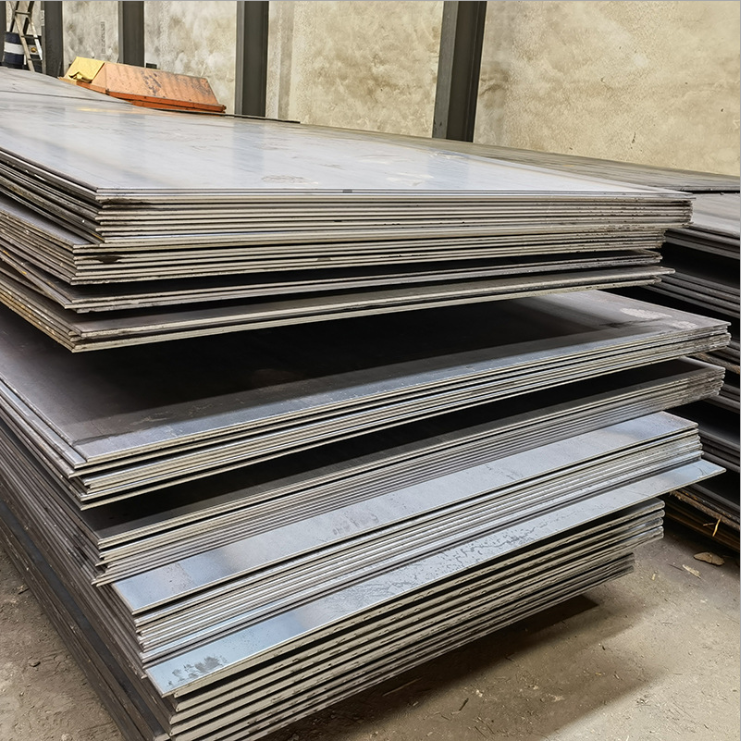
2. Core Advantage 2: Formation of a Dense, Adherent Protective Rust Layer
Corrosion resistance of S235J2W is essentially dependent on the formation of a "protective rust layer"-a key feature that ordinary carbon steel cannot achieve:
: In atmospheric environments, S235J2W undergoes a natural aging process (usually 6-12 months) to form a 50-100μm thick dense rust layer. This layer adheres tightly to the steel substrate, like a "protective coat" that blocks moisture, oxygen, and corrosive ions (e.g., Cl⁻ in coastal areas) from penetrating.
: Ordinary carbon steel forms loose, porous rust that has no protective effect. The rust expands when it absorbs moisture, causing peeling and cracking, which continuously exposes new steel surfaces to corrosion-leading to rapid thickness loss and structural damage.
3. Practical Performance Advantages: Longer Service Life & Lower Maintenance Costs
: In typical atmospheric environments, S235J2W's corrosion rate is only 1/5-1/10 of that of ordinary carbon steel. For example, in inland industrial zones, ordinary carbon steel loses 0.1-0.2mm thickness annually, while S235J2W only loses 0.01-0.04mm.
: S235J2W requires no regular anti-rust painting (after the protective rust layer forms), while ordinary carbon steel needs repainting every 2-3 years-greatly reducing maintenance costs and downtime, especially for large outdoor structures (e.g., railings, facades).
: S235J2W can withstand coastal salt spray, industrial SO₂ pollution, and humid heat environments. Ordinary carbon steel, however, corrodes rapidly in these scenarios, often failing within 3-5 years.
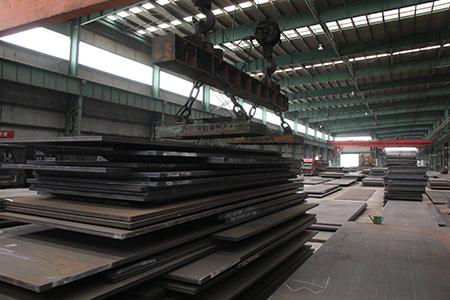
To maximize S235J2W's corrosion resistance advantage, avoid covering its surface with paint or coatings prematurely (which blocks the formation of the protective rust layer). In the initial installation stage, ensure the surface is clean and dry to facilitate natural aging of the rust layer. For ultra-harsh environments (e.g., heavy industrial pollution), a thin layer of breathable Corten maintenance oil can be applied to accelerate rust layer formation.

In summary, S235J2W Corten Steel's corrosion resistance advantages over ordinary carbon steel stem from its weather-resistant alloy composition and the formation of a dense protective rust layer. These advantages translate into longer service life, lower maintenance costs, and better adaptability to harsh environments-making it a more cost-effective choice for outdoor and industrial applications requiring long-term durability.


